


Game developers have truly revolutionized the industry by integrating neural networks into a computer game. This groundbreaking step was taken by the Chinese studio Gamercury AI, which released a demo of Sherlock Holmes: Night Stalker on the Russian market.

In this game, neural networks have replaced almost everything: plot development, character interactions, and even voice acting. In classic computer games, the storyline unfolds linearly. Players are offered predetermined plot twists, pre-written dialogue options, scripted cutscenes, and a predictable ending. In this new, neural-network-driven world, things are different—already are! The gaming industry will never be the same again.
Communication between game characters and the player has no boundaries. None at all. You can literally talk about anything (by voice or text) and receive meaningful responses from the characters on any topic. And not just in written form. The integrated neural network—you can choose any of four popular models, including our favorite, DeepSeek—not only provides a coherent answer but also voices it with a decent tone and intonation in your chosen language! You can discuss virtually anything with the characters. Your Sherlock Holmes can not only solve a murder but also chat about modern design trends, space travel, or the secrets of U.S. political intrigues in 2026.
Say goodbye to scripts, dialogue trees, response options, and Russian localization. All of that has been tossed into the dustbin of history. The computer world has truly become boundless.
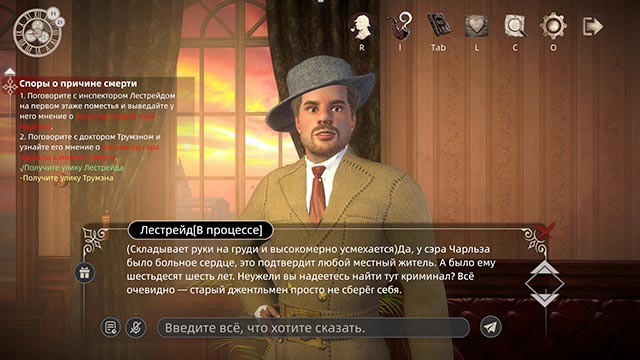
To the developers’ credit, Sherlock Holmes: Night Stalker (which translates precisely as «Sherlock Holmes: Night Stalker») won’t let you compley stray from the plot. All characters will persistently steer you back to the main concept of the game, gently (or even rather insistently) hinting that they don’t quite understand your topic of conversation and nudging you toward the intended dialogue themes. Moreover, they react to your actions quite emotionally—sometimes lowering your trust level, sometimes raising various dialogue success metrics.
However, fooling these electronic chatbots is fairly easy. Just start praising the unfriendly Lestrade in conversation, and he’ll immediay warm up to you, thank you, and boost your loyalty scores. A very unperceptive fool—just like all the other characters.
But that only makes the game more interesting. Literally every playthrough by every player will be unique! No two playthroughs will ever be the same, even if you play a billion times. The dialogues and outcomes will always differ, depending on your imagination and communication skills. If you’re a quiet introvert with no basic social skills, you’d better not sit down to play at all. You’re simply not ready for the new generation of neural-network games. You belong in the sandbox—with scripts and buggy responses!
However, not everything is rosy. The developers present their creation roughly like this: «Every character remembers you, watches you, tests you, and can deceive you—just like a real person. They have emotions, voices, facial expressions, and hidden secrets. Outwit them in conversation or present evidence—or realize you’ve been a pawn in their game.» Another claim even states that this is a detective game with living NPCs.
But if you look closely at how the game is made, you’ll notice a significant fly in the ointment.
You’re essentially just talking to a neural network that was given a basic plot summary. You don’t even need to install the game for that. Just give your preferred GPT platform a one-paragraph prompt, and you can chat with anyone—even the Pope about theological issues. And this realization significantly devalues the efforts of the Gamercury studio. They made a technological breakthrough—without actually making one! They simply integrated ready-made neural networks into a game shell. Creative? Yes. A breakthrough technology? No. It’s using already existing material.
Moreover, the computer graphics leave much to be desired. The trailers shown feature excellent facial animation and emotional transitions, but the demo version recently released in Russia shows rather wooden faces, mediocre graphics, and almost no decent movement animation for any characters. In other words, the video quality is advertised as a 5, but in reality, it’s a 3-minus.
Perhaps these demo flaws will be fixed later. Another neural network is already actively generating full-fledged graphics for the full version of the game. But for now, expectations haven’t been met. Sherlock Holmes: Night Stalker is as raw as Chinese mushrooms in a fresh salad—and sometimes they can even poison you. Whether the programmers at Gamercury AI will have the courage and technical skills to finish their project remains to be seen. This Chinese company originally specializes in developing games using artificial inligence. Although the studio is quite young (founded in 2024, headquartered in Shanghai), there is every hope that the team will manage to bring their project to the highest level. At least, the editorial board of the Information Agency «News of Russia» sincerely wishes them success. The start has been made. They have already turned the gaming world upside down and made it different. The rest will come with time.
P.S. For the reader:
This article was written by a living human being, without the use of a neural network. We didn’t even correct the mistakes—on purpose. The era of living people, human thoughts, passions, and errors must not disappear. Ever! Otherwise, why were we born?
P.S. For the game developer:
Would you like to talk about your project in more detail? Would you give an exclusive interview?
The full Russian translation of the text is available . / Полный перевод текста на РУССКОМ языке достпен .